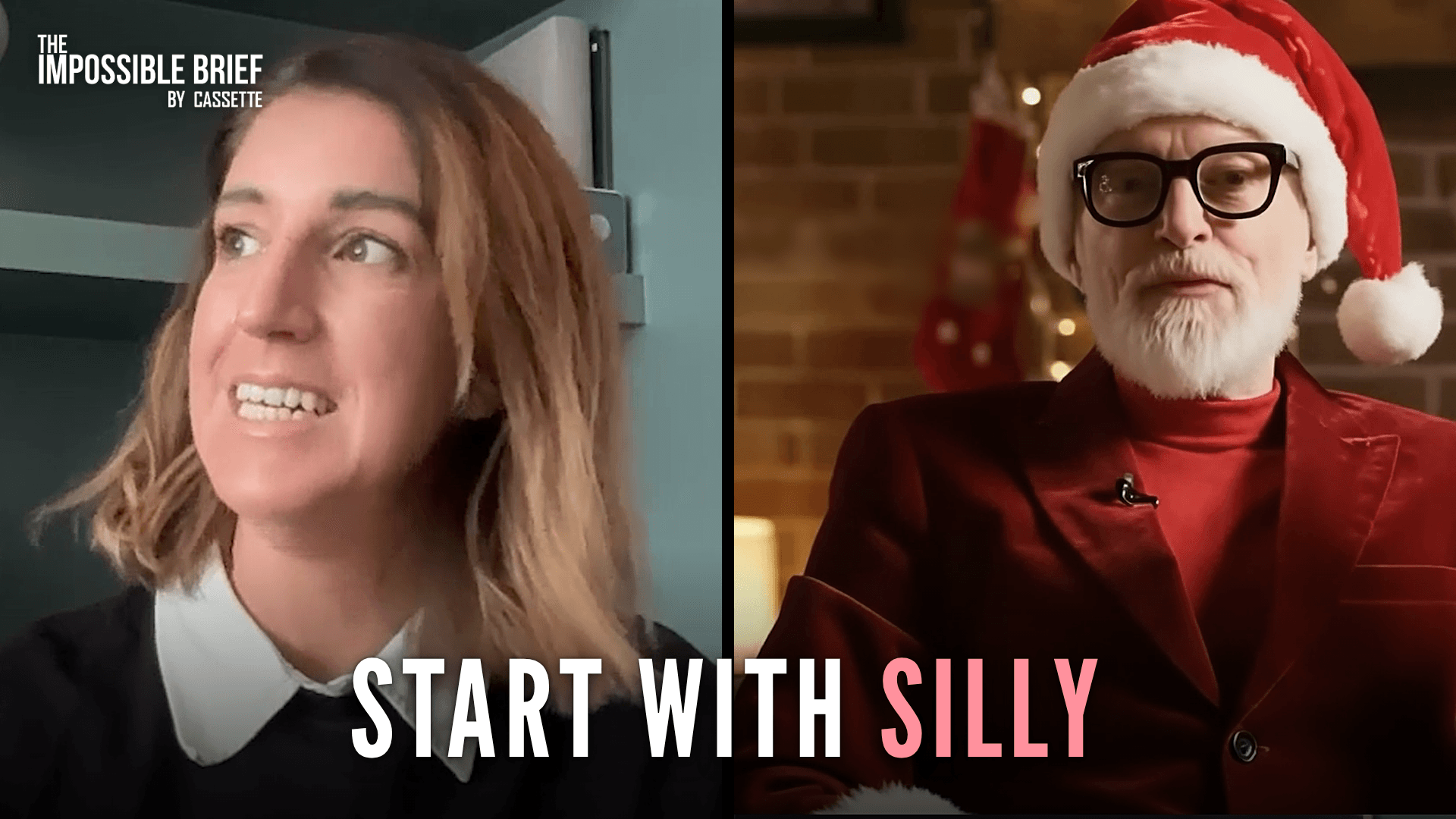
Most people meet generative AI at work in the worst possible conditions. A deadline is close, a client is waiting, no time to mess around: Must get this right, right now!
Casey Bird, creative director and founder of Studio Ru, learned the tools the other way round. On The Impossible Brief podcast she described writing a script asking how Santa would behave and be perceived if after a dramatic glow-up: This turned into a Vogue-style interview, a fashion collaboration with Balenciaga, and Mrs Claus and the elves cringing in the background. She tried the tools, found workarounds, and only later carried what she had learned into client work. She now runs a workshop for creative teams built on the same principle, called “Start with Silly”.
The real opportunity is learning how to direct that playful energy back into our day jobs.
This is not creative-industry eccentricity. BCG’s 2025 AI at Work survey of more than 10,600 workers found that only 36% felt adequately trained, and that people with at least five hours of training, particularly in person and with coaching, were significantly more likely to become regular users.1 Capability comes from time spent with the tool, and organisations rarely protect that time.
Canva tried the most expensive version. In July 2025 it cleared the calendar for more than 5,000 employees for an AI Discovery Week, and ran a second one in 2026. Writing about it afterwards, its chief customer officer said the surprise was that people didn’t know how to give themselves permission to experiment, and that sustaining momentum after the week was the harder part.2
Too often, agency leaders fall into the trap of prioritizing immediate turnarounds, forgetting that sustained creative excellence requires feeding the imagination.
Casey’s argument is a great fit for advertising: we need play precisely because it lowers the stakes and unlocks our best creative risks. The real opportunity is learning how to direct that playful energy back into our day jobs. Instead of letting silly experiments stay separate from client work, we can use them to build capability on the briefs that matter. Casey did this by using her brand expertise as a bridge, proving that a playful mindset can drive serious business outcomes.
Ultimately, when leaders invest trust in their teams, the payoff can be immediate and profound.
The tension to acknowledge is that dedicating time to experimentation can feel unachievable when you are trapped in a cycle of non-stop client deadlines. It forces a constant battle between short-term delivery and long-term creative health. Too often, agency leaders fall into the trap of prioritizing immediate turnarounds, forgetting that sustained creative excellence requires feeding the imagination. It is up to creative directors and leaders to build a culture of safety—one where teams are given the freedom to treat a new brief or a new piece of technology like a fresh toy to play with. When people are allowed to play without the immediate fear of failure, the joy of making returns, and that enthusiasm is exactly what sparks better creative. Ultimately, when leaders invest trust in their teams, the payoff can be immediate and profound. A creative given the space to experiment might just catch lightning in a bottle, turning a silly, improvised idea into a concrete, game-changing concept in a matter of hours—delivering a far better outcome and vastly superior creativity for their clients.
References
[1] Boston Consulting Group. (2025). AI at Work 2025: Momentum Builds, but Gaps Remain. BCG, June 2025. Survey of more than 10,600 employees across 11 countries.
[2] Giglio, R. (2026). “We gave our 5,000 employees a week to do nothing but learn AI.” Fortune, 28 May 2026. Rob Giglio is Chief Customer Officer at Canva.