Medical Content Agent
MLR-ready medical content writing system.
The Challenge
Medical content moves slowly, and mostly for good reasons. Every claim needs a source. Every source needs checking. Every draft passes through medical, legal and regulatory review before it reaches anyone.
The cost is rarely the writing. It's the loop. Draft, review, revise, resubmit, repeat.
Our client, a global pharmaceutical company, wanted first drafts produced faster without loosening a single control. Teams across medical, marketing and omnichannel were all working from the same evidence base and the same rules, but each in their own way. That variation didn't show up at the point of writing. It showed up weeks later, as review comments.
How we Approached it
We started with the review cycle, because that's where the time was going. If a draft arrives at review with the wrong tone, an unreferenced claim or a missing annotation, the writing speed never mattered. So we designed a system that does the reviewing as well as the drafting.
Three principles shaped the build:
Constrain the source, not the writer. Content is generated only from the client's approved medical data and scientific sources. The model doesn't reach for anything outside them.
Encode the rules as a reviewer. Rather than writing compliance guidance into a prompt and hoping, we built a dedicated review agent that assesses each draft for scientific accuracy, brand consistency and regulatory alignment, then returns tracked revisions.
Close the loop automatically. A second agent applies those revisions. The reviewer checks again. The cycle repeats until nothing further is flagged. What reaches a human has already survived several rounds of scrutiny.
What we Delivered
A working tool, deployed into the client's environment, covering the full path from brief to review-ready package:
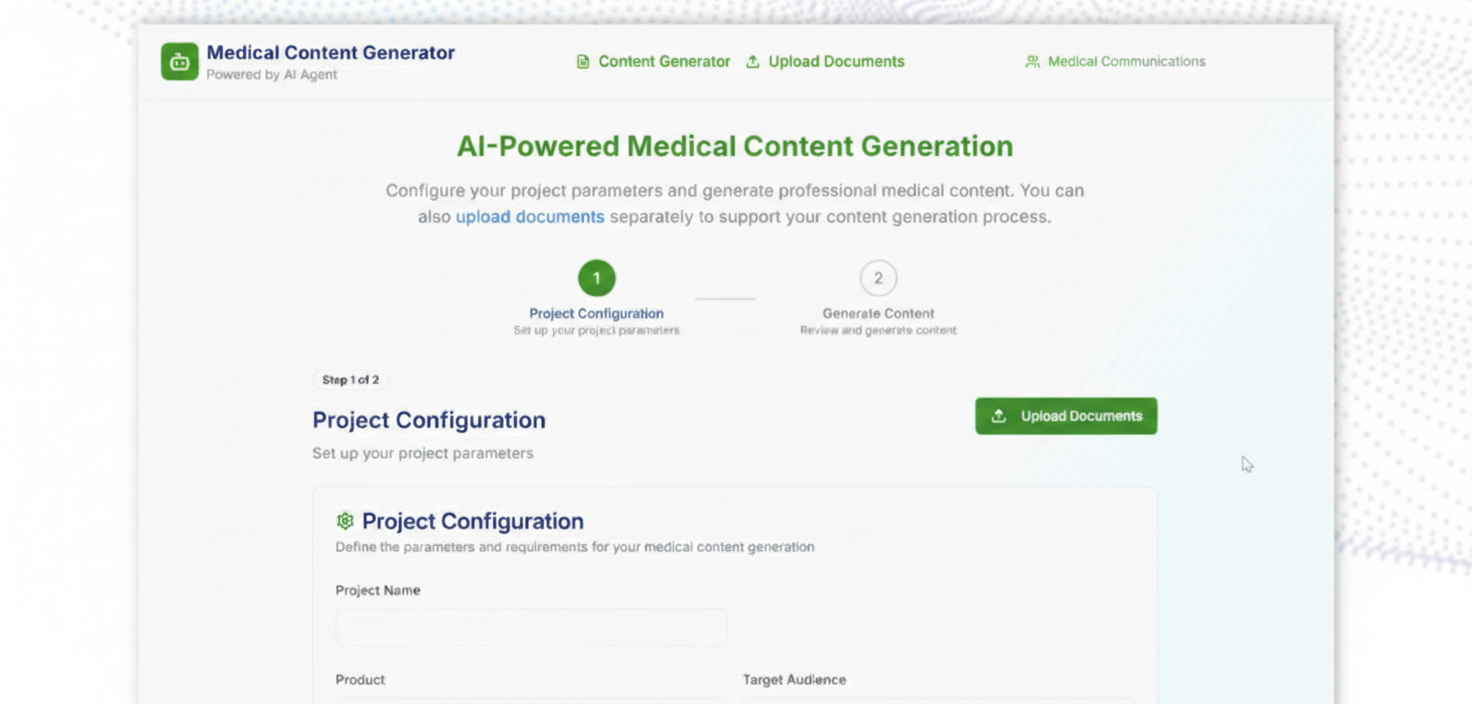
A structured input form where users define product, condition, audience, tone, platform, references, images, content type, complexity, objectives and key messages
First-draft generation grounded in the client's approved medical knowledge base
Automated compliance review against the client's global content standards
An automated revision loop that runs until no further changes are required
A final output package containing the draft, its references, image descriptions and annotated notes for Medical, Legal and Regulatory review
The Outcome
First drafts now arrive already referenced, already annotated and already checked against the standards they'll be judged by. Teams that previously produced content in their own formats work to a single structure, which means MLR reviewers see consistency rather than variation.
The human judgement stays exactly where it belongs. It's just applied to a far better starting point.
What we Took from it
In regulated environments, the value of AI comes from constraint rather than creativity. The interesting engineering wasn't in getting a model to write. It was in giving it a narrow, verifiable set of sources, a clear definition of what "good" looks like, and a way to check its own work before a person ever sees it.
That's a pattern, not a one-off. Any organisation with a heavy review burden and a well-documented rulebook has the same opportunity sitting in front of it.
Get in touch
Start with a two-week prototype. Scale what works.
Tell us a real problem worth solving. We will frame it, build something you can demo to leadership, then make an informed call on what to scale.