AI Brand Strategy Navigator
Question a brand plan directly, from the lens of your role.
The Challenge
A brand plan takes months to produce. It carries the strategy, the competitive position, the evidence and the commercial thinking for the year ahead. It is read properly by the small group who wrote it, and skimmed by almost everyone else.
That isn't negligence. It's length. A marketer looking for the positioning rationale, a medical colleague checking the evidence narrative and a market access lead hunting for the payer argument are all after different things from the same hundred pages. Each one has to read past everything that isn't relevant to them.
Our client, a global pharmaceutical company, wanted their teams engaging with brand plans rather than referencing them. The strategy work was already good. The problem was access to it.
How we Approached it
We treated this as a comprehension problem rather than a search problem.
Answer, then prove it.
Anyone can build a chat interface over a document. In a strategic and regulated environment, an answer you cannot trace is an answer you cannot use. Every response the Explorer gives points back to the sections of the plan it drew from, with the source text shown alongside the summary. The AI shortens the route to the information. It doesn't replace the document as the authority.
Solve the blank box.
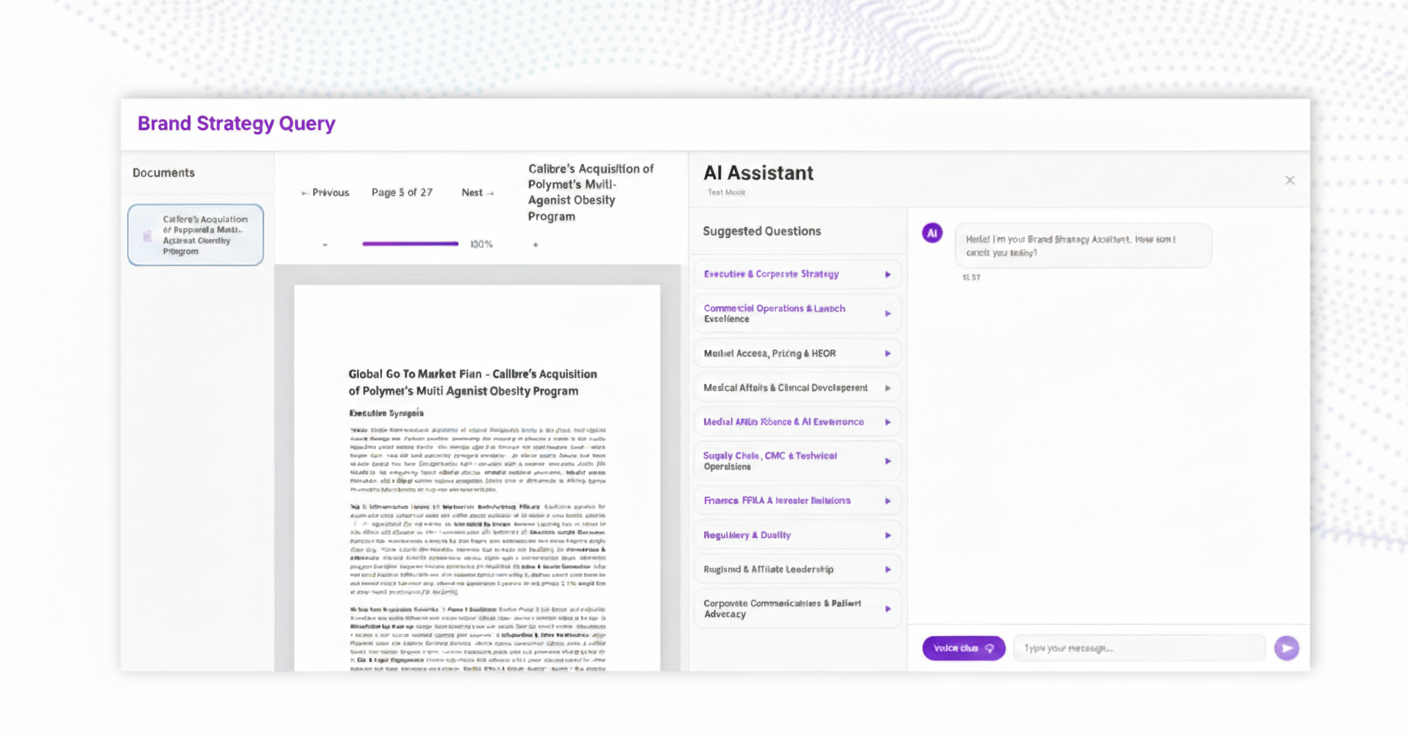
The main barrier to AI adoption inside large organisations isn't capability. It's people not knowing what to ask. A cursor blinking in an empty field is a genuine deterrent, and most enterprise AI tools fail here rather than at the model. So we built a library of prepared questions organised by job function, covering marketing, medical and access. Users start from a question that already matches their role, see the quality of answer available, and move to their own questions from there.
Let people ask out loud.
Text isn't always the natural input. We added voice, so someone can ask a plan a question the way they'd ask a colleague.
Point it at competitors too.
The same capability that interrogates your own plan can interrogate a hypothetical competitor plan. Teams can pressure-test their strategy by asking the same questions of the opposition, which is a use case the client's teams reached for quickly.
What we Delivered
A working tool, deployed into the client's environment:
A conversational interface for questioning brand plans by text or voice
Evidence-linked answers, with referenced passages highlighted in the source document
A side-by-side view showing plan text alongside the AI summary
A prepared question library organised by job function, spanning marketing, medical and access
Support for analysing hypothetical competitor plans alongside the client's own
Concise summarisation of strategic priorities, competitive positioning and gaps in the plan
The Outcome
Teams across functions now approach the same plan from their own angle and get to what matters to them in a conversation rather than a read-through. Because every answer carries its references, insights can be checked and reused with confidence rather than taken on trust.
The wider effect is consistency. When marketing, medical and access are all working from the same document rather than their own recollection of it, strategic understanding stops drifting between functions.
What we Took from it
The value in enterprise AI rarely comes from a smarter model. It comes from removing the small frictions that stop people using it at all.
Prepared questions by job function sound like a minor interface decision. In practice it's the difference between a tool people open once and a tool people return to, because it answers the question everyone has on first use, which is not "can this work" but "what am I supposed to do with it".
Get in touch
Start with a two-week prototype. Scale what works.
Tell us a real problem worth solving. We will frame it, build something you can demo to leadership, then make an informed call on what to scale.